




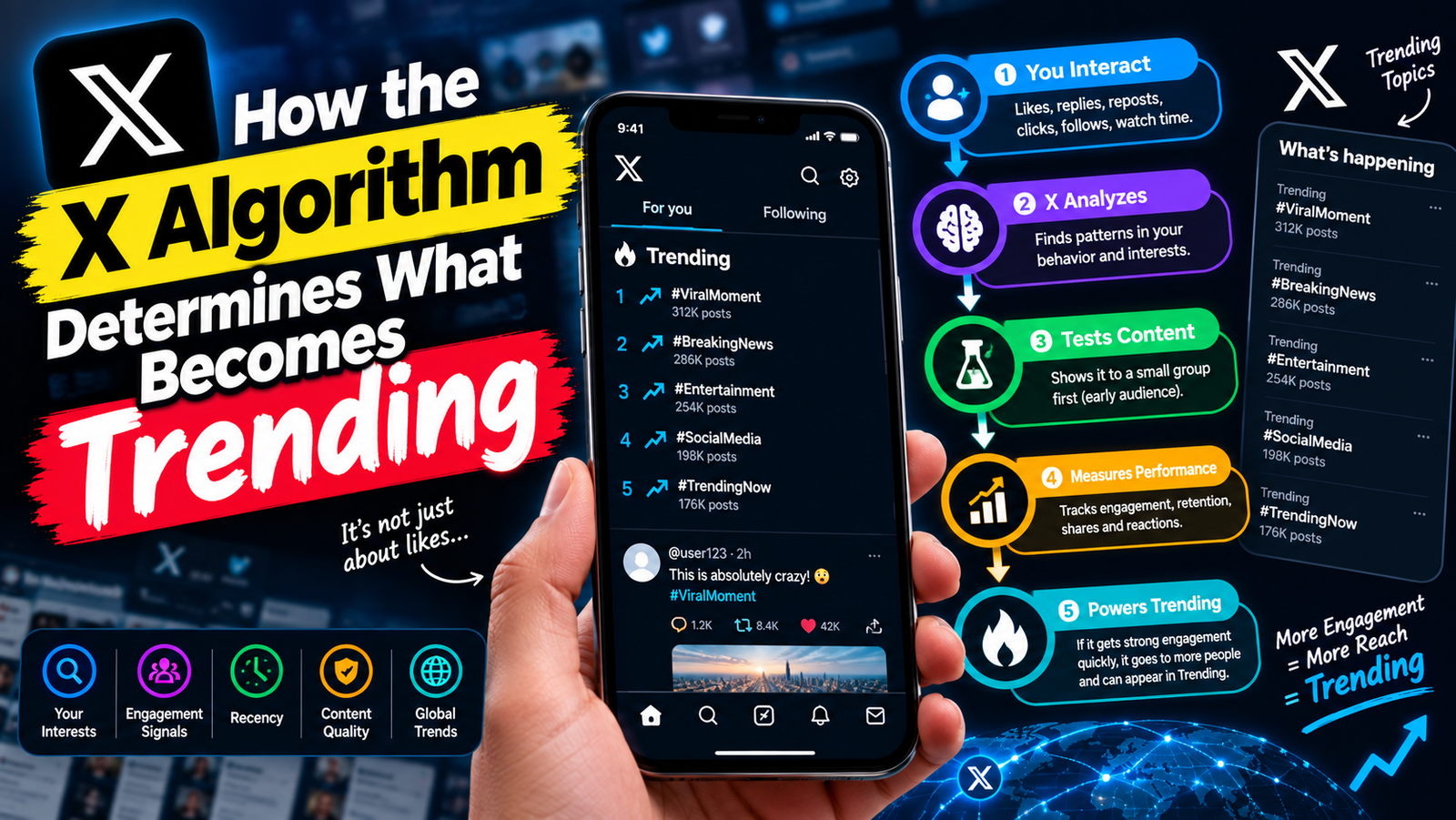
X handles millions of public posts each day, yet only a small group of topics appears in the Trending section. That gap raises a useful question: why does one fast-moving phrase gain platform-wide attention while another viral post disappears from view?
The X algorithm determines what becomes trending through more than raw post volume. Conversation speed, unique participants, searches, topic clarity, location, user interests, real-time events, and safety checks can all affect visibility. The exact formula remains private, but these signals explain why some posts trend, why others don’t, and how brands can join active discussions without looking spammy.
Trending Topics Reflect Conversation Velocity, Not Just Popularity
A topic can stay popular for months without trending today. X tends to surface subjects that are gaining momentum now, rather than topics with the largest lifetime audience.
Volume matters, but growth rate matters more
A sudden rise in posts, reposts, replies, and searches can signal an emerging conversation. A smaller topic with rapid growth may outrank a huge topic with steady activity because the trend system looks for change within a recent time window.
Timing matters during breaking news, live sports, product launches, and cultural events. A topic that gains thousands of posts in 20 minutes may carry more current interest than one that receives the same number over a week. X does not publish the exact thresholds or ranking formula, so no outside source can guarantee the point at which a topic becomes trending.
Unique participation strengthens a trend signal
Activity from many distinct accounts gives a stronger picture of broad interest than repeated posts from a small group. Varied opinions, original replies, and new participants suggest real discussion rather than a narrow campaign pushing the same phrase.
A topic with 50,000 posts may still look weak if most came from the same accounts or copied one message. Check whether new communities are joining the conversation, not only whether the post count keeps rising. Search activity may add another clue, especially when people seek information about a news event, game, release, or public announcement.
How the X Algorithm Determines What Becomes Trending
X must decide whether separate posts refer to the same subject. Users may discuss an event with a hashtag, a person’s name, a nickname, or a phrase with no shared tag at all.
Hashtags group visible conversations
Hashtags help connect public posts and make an event easier to find. Yet using a hashtag does not guarantee trending status. X can consider the tag’s growth, volume, relevance, and relationship to wider discussion.
A precise tag usually gives an event clearer focus than a broad or ambiguous one. If you join a live conversation, use the recognized phrase and add useful commentary. Adding unrelated trending hashtags can make a post look like keyword stuffing.
Keywords and context connect related posts
Topic recognition can include names, keywords, entities, spelling variations, abbreviations, and natural-language references. A conversation may build momentum even when no single hashtag dominates.
Context still matters. One keyword can refer to several unrelated events, while sarcasm, copied text, or spam can create misleading spikes. Review representative posts before treating a trend label as a complete description of the discussion.
Location and Personalization Change X Trends
Trending lists aren’t necessarily identical for every user. Location, language, account settings, followed accounts, engagement history, and inferred interests can shape what appears in discovery areas.
Local interest can outrank global popularity
A topic may trend in one city, country, or region without becoming a national or global trend. Local elections, weather alerts, regional sports, transport problems, and community events can create intense discussion among a nearby audience.
When researching trends for a local campaign, select the location that matches your audience. A worldwide trend may bring attention but little local relevance, while a city-level topic may reach fewer people and produce better results.
User interests affect what people see
Two users can receive different suggestions because they follow different accounts and engage with different subjects. A fan of one sport may see a related game trend sooner than someone with no history in that topic.
Personalized recommendations and public Trending lists are connected discovery systems, but they aren’t necessarily identical. A niche topic can feel highly visible to one audience while remaining nearly invisible to another. Language settings, regional terms, spelling, and local slang can create similar differences.
Safety and Authenticity Filters Shape Trending Results
Virality alone does not guarantee promotion. X applies quality and safety systems to limit spam, manipulation, harmful content, and misleading activity.
Repetition and coordination can reduce visibility
Automated posting, copied messages, engagement exchanges, misleading hashtags, and organized attempts to force a topic into Trends can weaken a conversation’s trust signals. Legitimate collective participation looks different when people share independent reactions, firsthand details, and varied points of view.
X’s Rules on platform manipulation and spam prohibit behavior intended to artificially amplify or suppress information. For creators and brands, original commentary and meaningful replies are safer than copy-paste amplification.
Policy-sensitive content may be excluded
Content that violates rules may be removed, restricted, downranked, or excluded from recommendation and trending surfaces. The X Rules cover areas such as harassment, hateful conduct, violent threats, privacy violations, civic manipulation, and deceptive identities.
A subject can receive widespread discussion without receiving broad promotion. Moderation decisions may involve automated tools, human review, reports, and account history rather than one simple rule. X’s rules enforcement transparency report describes enforcement as a process designed to address violations and protect public participation.
Real-Time Events Create Fast Trending Momentum
Live events produce concentrated bursts of activity. They give thousands or millions of people a shared reason to post at nearly the same time.
Breaking news can trend within minutes
Major announcements, emergencies, political developments, and public incidents can cause sharp increases in posts and searches. Early claims may be incomplete or wrong, so check official statements and credible reporting before sharing them.
Eyewitness content can add value, but it may lack context. A fast response is useful only when accuracy comes first. Do not repeat an unverified claim because a keyword is rising.
Sports and entertainment synchronize audiences
Games, award shows, premieres, concerts, and music releases create clear time windows for discussion. Official event hashtags may compete with audience-created phrases, especially when a surprising play, quote, or performance captures attention.
Planned campaigns can support a live moment, but unexpected reactions often move faster. Brands should prepare flexible content and avoid forcing themselves into unrelated tragedies, controversies, or emotional events.
Creators and Brands Can Earn Relevant Visibility
No tactic guarantees trending placement. The strongest approach is timely, relevant participation that adds something new to a conversation already gaining speed.
Publish while interest is accelerating
Monitor official announcements, event calendars, audience questions, and reliable social listening data. Join before a topic reaches saturation, but don’t rush an inaccurate post to beat competitors.
Useful contributions may include expert analysis, firsthand experience, clear explanations, data, visuals, or practical help. A duplicate reaction adds little, even when it includes a popular hashtag.
Measure value beyond Trending
Trending visibility can increase reach without producing qualified attention. Track profile visits, meaningful replies, website traffic, conversions, sentiment, and audience growth alongside impressions.
Compare results by topic, format, location, and publishing time. X can change its ranking and trend systems, so date-stamp platform observations and check current X Help Center materials, Rules, engineering updates, and transparency reports before treating any factor as confirmed.
Conclusion: Momentum, Relevance, and Trust Drive Trends
The X algorithm generally favors rapidly growing public conversations over subjects that are merely popular. Strong signals include conversation velocity, unique participation, search interest, clear topic meaning, local relevance, personalization, and real-time timing.
Spam, copied activity, manipulation, policy violations, and low-quality engagement can prevent a topic from receiving broad visibility. The most sustainable way to join a trending conversation is to respond quickly, add original value, verify important claims, and stay aligned with the audience and event.
Treat the Trending section as a discovery signal, not proof that a topic is true, important, or commercially valuable. Use it to spot momentum, then judge the opportunity through context and results.